Showing posts with label Jenny Lerew. Show all posts

Monday, April 14, 2014

WALT DISNEY FAMILY MUSEUM HOSTS WOMEN IN ANIMATION PANEL: Luminaries in the industry showcase how to succeed and thrive in the fun and challenging world of television and feature film animation

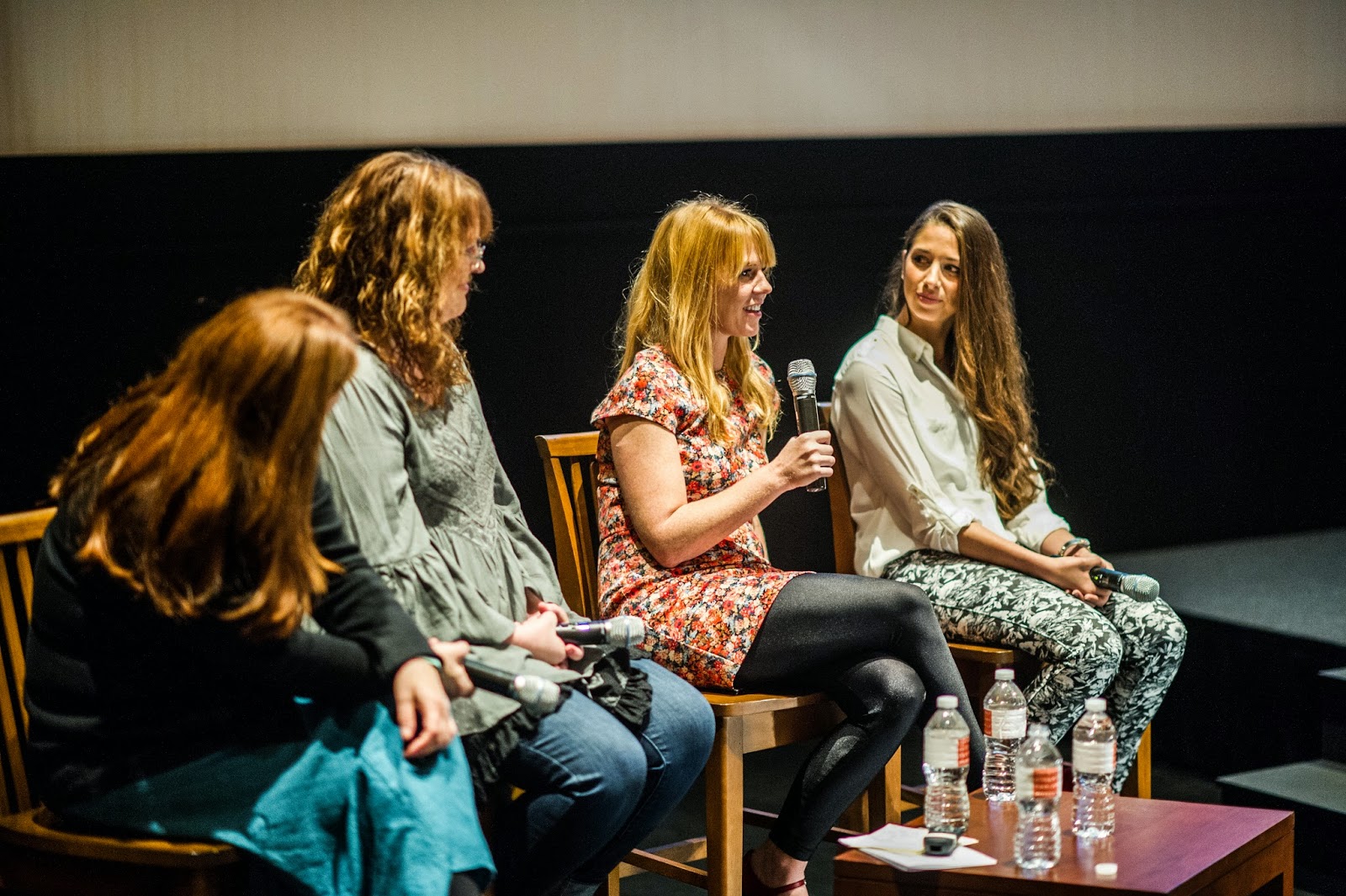
The ILM theatre was a buzz on Saturday March 15th as animation veterans Jenny Lerew, Brenda Chapman, Claire Keane and Lorelay Bove regaled the packed house with stories of their work on films like The Lion King, Frozen, The Prince of Egypt, Tangled and Peabody and Sherman.


Audience members at the Women in Animation panel.

Presented by the Walt Disney Family Museum in conjunction with their latest exhibit, MAGIC, COLOR, FLAIR: the world of Mary Blair, WDFM’s public programs manager Mary Beth Culler and exhibition curator, animation director, and author John Canemaker introduced the Women in Animation panel.

Jenny Lerew, director of the hit 90s television show Animaniacs, author of The Art of Brave and most recently, storyboard artist for Peabody and Sherman, moderated the event for the over 200 animators and animation fans in attendance.

DISCOVERING ANIMATION: CALARTS AND BEYOND

Lerew kicked off the talk by answering a question she is often asked, usually by men, “Why aren’t there more women in animation?”

“It's a good question,” said Lerew. “I can tell you why this woman is in animation. Like all of us, I loved cartoons and I also grew up as an artist, I loved to draw." However, animation was not on her radar, until she learned about California Institute of the Arts, or CalArts, in high school.

In fact, Lerew first learned about Brenda Chapman through CalArts in 1987 after seeing her student film A Birthday. The film, about an old woman remembering her birthday as a little girl, made quite an impression on Lerew, and helped encourage her to tell her own stories.

"Now there are hundreds of places you can go and it's on everyone's radar,” said Lerew.

Brenda Chapman learned about CalArts from a friend of a family friend who worked at Disney Feature Animation. At the time story was not even offered as a course, so students learned from the upperclassmen. In 1987 she earned a spot as a trainee at Disney, where she was frankly told  “they were happy to have you. We needed a woman that's why you're here. And you have six months to prove yourself.”
Brenda Chapman, Claire Keane, John Canemaker, Jenny Lerew and Lorelay Bove at the event.

Prove herself she did, working as a story artist on Beauty and the Beast and
The Lion King at Disney, and later becoming the first woman to direct an animated film for DreamWorks' The Prince of Egypt.

Lorelay Bove, another CalArts grad, recalled being enthralled by the film Fantasia at age eight, a film, she discovered, that was not as beloved by her fellow classmates.

“Everyone at school hated it, but I loved it,” recalled Bove. Along with Disney films, she also experience art by spending time in her father’s art studio, where he worked as an abstract painter.
From a young age she knew she wanted to work at Disney, something that most people she knew in her native Spain did not understand.  After moving to the states with her family, her father found out about CalArts. She applied, was not accepted, but did not let that deter her. She studied at another college for three years, reapplied to CalArts, was accepted, and later served as an intern at both Pixar and Disney.

Bove then took a job as a visual development (Viz Dev) artist at Disney, working on The Princess and the Frog, Wreck-It-Ralph and this fall’s upcoming super hero adventure Big Hero Six.

Claire Keane took a different path, attending graphic design school and creating a storybook as her thesis.

"What I loved the most was all the research,” said Keane.

She loved creating developmental drawings, but did not believe that there was a way for her to create what she wanted for film. That was, until a conversation with her father, animator Glen Keane, changed her mind.

“Claire, that exists,” said Keane, laughing as she recalled her father’s words. “We have visual development artists at Disney.”

His advice inspired Keane to apply to Disney, where she worked as a Viz Dev artist on both Tangled and Frozen before leaving to work on her children’s book that will be released in 2015.

CREATING A FILM: ONE DRAWING AT A TIME

Each of the panelists along with moderator Lerew shared some of their favorite studio work, and a few of their personal projects, enabling the audience to glimpse a behind the scenes look at what goes into making a film.

“I can only work from what I know,” said Keane. “Anytime I start drawing something I don't have an emotional connection to I can't draw it. My hand just draws in circles.”

In order to create that emotional connection between herself and Rapunzel from Tangled, Keane stayed home one weekend documenting everything that she did, while at the same time imagining all of the activities Rapunzel would engage in if she were unable to leave her own home.

“Maybe she had an imaginative imagination,” said Keane. “What would her paintings look like in the dark. Happiness? Fear of the outside world? Chores? Make her bed, make candles, brush her hair. Fascination with birds -- they fly, they don't get eaten by monsters, they return.”
Claire Keane discusses her artistic process while at Disney.

The practice allowed her to get into Rapunzel’s head and see the world the way that the character would.

Lerew showed her boards and animatic from a scene of Peabody and Sherman, the first scene to be animated for the film. In the scene, Sherman reluctantly tells Mr. Peabody of an altercation he experienced at school. Lerew showed both the storyboards, as well as the final animation of the scene, to highlight the similarities

and differences between what goes into the boards and the final product.

Bove showed backgrounds from Sugar Rush, the racing game that serves as a turning point in last year’s hit film Wreck-It-Ralph. Her designs were inspired by Spanish homes that “looked like candy.” In fact, research is one of the best parts of the job.

“[We] went to a candy convention in Germany that was three stories tall. The Comic Con of candy,” said Bove.

Chapman showed boards from Beauty and the Beast where Belle nurses the Beast’s wounds, as well as the scene from Brave where Queen Elinore and Princess Merida clash and Merida slices through the family tapestry.

“This is the crux of the movie, it sets the scene,” explained Chapman of the scene from Brave.
Mom is trying to do her best, and the daughter is trying to exert her independence, according to Chapman, and both are right and wrong.

“Most fairytales involve moms or stepmoms that are either horrible or dead. I wanted to show a family,” said Chapman.

QUESTIONS FROM THE AUDIENCE

The panelists also took time to answer questions from the audience, ranging from what studios look for in a portfolio, and both Keane and Bove agreed that it was better to show your best work than a ton of everything.

 “Put in the best work that represents you,” said Keane. “Focus on the character or environment and make that image say what you want it to say.”

The panelists also addressed what it is like seeing your creation as merchandise.

“For the most part it’s very positive,” said Chapman. “If I can make one little kid forget their problems at home, then I’ve done my job.”

Chapman also addressed the darker side of merchandising, recalling the now famous incident of the change in Merida’s design from Pixar heroine to the more traditional Disney princess look.

“The ‘princessing’ of Merida was not good, I put up a stink about that,” said Chapman.

They also addressed the lack of female representation in film, and what creators can do to rectify the situation.

The key, said Keane, is to have “someone who is grounded in reality. No more clichés – that’s any character in animation, not just women.”

Chapman, and the other women on the panel, are living proof that animation will continue to inspire.  Now when she goes to lecture at CalArts, 52% of the women are students.

“Just do it,” said Chapman. “First, learn how to work in the studio system. Then, learn how to make your mark.”
---
Special thanks to the Walt Disney Family Museum for planning the event and providing the photographs, ILM for hosting, Jenny Lerew, Brenda Chapman, Lorelay Bove and Claire Keane for discussing their work and life through animation and John Canemaker for curating the WDFM exhibit.

And you can see more of the artists’ works on their websites:


John Canemaker
http://www.johncanemaker.com/

Brenda Chapman
http://brenda-chapman.com/

Lorelay Bove
http://lorelaybove.blogspot.com/
 

Claire Keane
http://claireonacloud.com/


Jenny Lerew
http://blackwingdiaries.blogspot.com/


And visit the Walt Disney Family Museum to see their latest exhibit:
MAGIC, COLOR, FLAIR: the world of Mary Blair through September 7, 2014

For information on Women in Animation San Francisco and animation events happening around the San Francisco Bay Area:


Visit our Website:

www.womeninanimationsf.blogspot .com

Join our Facebook Group:
https://www.facebook.com/wiasf


And follow us on Twitter:
@WIASanFrancisco

Tuesday, February 25, 2014

Guest Columnist Jenny Lerew: A Commentary on Women in Animation

In the 1970s there was one must-have for every aspiring young animator's bookshelf: Christopher Finch's oversized, heavy and beautiful The Art of Walt Disney.  Illustrated books detailing the history of animation, and more specifically, the Disney Studio, were almost nonexistent at the time; and at over 400 pages the Finch book was something I pored over for hours. I'd already fixed on the idea of being an animator, seeing it as the perfect career to marry my love of drawing, film, and performance.  I considered animation to be "the illusion of life": turning lines on a page into characters that lived and breathed in an invented world of color, design and graphic imagination.

Every page of Finch's book was filled with story sketches, animator's roughs, background paintings, and photographs– not just of Walt Disney, but also of his artists working at their desks, drawing just as I did and looking not much older than I was. But they were working on such memorable films as Snow White, Pinocchio, and Bambi.  Decades before I was born they'd managed to achieve the gold standard: working at the greatest animation studio in the world on films whose influence would long outlive them.

The old images fascinated me and I wanted to know more about them. One was particularly striking.  It showed a young woman, Retta Scott, animating on Fantasia.  While far from being an expert in either social history or 1930s studio-hiring practices, I knew that a woman employed as an animator in those days was rare, and that this had been the case from the beginning. The form of cartooning which preceded and inspired animated cartoons and newspaper comic strips, also had many more men than women employed in the field, and this disparity carried over into the new medium of animated cartoons. With rare exceptions, cartooning/animation work became a "guy's thing," though the intended audience for the cartoons and comic strips was both male and female.

So, by the mid-1930s, it seemed that any woman with artistic talent or experience who applied to a studio for work in animation was limited to a career in the "ink and paint" department, doing the crucial but creatively stultifying tasks of tracing animators' drawings on celluloid and painting the underside. This was by necessity an assembly-line sort of job, and while the women who did it were rightfully proud of their skills, the work certainly didn't allow for individual expression.  But there was Retta Scott, engaged in what was a traditionally male job. She was an anomaly—a female animator!  I later learned that Scott had worked in the story department as well as in animation, and in fact, there had been other women assigned to the story and development departments, including Sylvia Moberly-Holland, Bianca Majolie, and most famously, Retta's friend Mary Blair, whose career and influence would extend further than many of her colleagues'.

In the 1930s and '40s, a confluence of talent, opportunity, timing and connections were required for a talented woman to land a creative job at Disney.  This was also true for the men but to a lesser degree. It's impossible to know how many women who aspired to be animation artists were actively discouraged from trying, but certainly some were, as evidenced by the Disney Studio's 1930s form letter sent in response to women inquiring about jobs as artists. It stated that "women do not do any of the creative work in connection with preparing the cartoons for the screen, as that work is performed entirely by young men." While clearly untrue when one considers the placement of the women previously mentioned, the letter nonetheless expressed the company's attitude towards the idea of women artists in general.

This was unfortunate since not only were women at the Studio making artistic contributions, their work was also having a positive impact on the history of animation. The work of Mary Blair, in particular, caused a transformation in the look of Disney animation, and the opportunity for her to create stunning art was due to the direct involvement of Walt Disney, whose appreciation of her unique style and sensibility was not hindered at all by her gender. But Blair was a stunning exception; for most women, the opportunities to achieve personal distinction in animation were simply not available. Had it been otherwise, it's anyone's guess who else might have made her mark as Blair was able to.

Throughout my working life I've been asked the question, "Why aren't there more women in animation?" and I've never had an answer. I can only speak for myself and explain why I do what I do—a story that differs little if at all from that told by my female and male colleagues.  But while the question still gets asked, things have changed more rapidly in recent years than ever before. As a student at Calarts in the late 1980s, I was in a class where the guys far outnumbered the girls, and for the first decade or so I was able to tick off the names of all the other females who were somehow involved in animation.

Now, there are so many women working in the field that I can't begin to keep track of them all– many working as I do in story, but also in visual development, animation, character design, and every other classification. Online blogs by aspiring female animation students are even more numerous, and from a cursory check, show ever-increasing sophistication and range in personal style and storytelling ability.  It's a wonderful state of affairs for my industry and for everyone who's involved with the art of animation, and it'll be fascinating to see what the future will look like when a picture of a woman creating animation will draw no special notice at all.

Jenny Lerew is an animation story artist whose numerous film and television show credits include Animaniacs, Bee Movie, Shrek 2 and the soon to be released Mr. Peabody & Sherman. She is also the author of The Art of Disney/Pixar Brave available through Chronicle Books. 

You can see her at the upcoming Panel Discussion: Women in Animation hosted by the Walt Disney Family Museum and held at ILM on Saturday, March 15th. 

For more information on Jenny Lerew please visit her website at http://blackwingdiaries.blogspot.com/ or follow her on Twitter @blackwingjenny

Thank you to Jenny and the Walt Disney Family Museum for making this article and the upcoming talk possible. 

Monday, February 24, 2014

Walt Disney Family Museum Presents TALK | Panel Discussion: Women in Animation March 15th @ ILM

This Just in!

Due to the overwhelming response to the upcoming Women in Animation Panel hosted by the Walt Disney Family Museum the venue has been moved to the Lucasfilm/ILM Premier Theater

and ticket sales have been increased to accommodate more people.

Anyone interested in purchasing a ticket to this highly anticipated presentation can visit the Museum’s website at www.waltdisney.org. 

Schedule for March 15th:

11am-12:30pm Presentation at Lucasfilm/ILM Premier Theater
(Metered parking available at the Museum or side streets by Lucasfilm, or in the Lucasfilm garage for $5.00) [Lucasfilm/ILM is located in the Letterman Digital Arts Center at One Letterman Drive, just inside the Lombard Gate on the eastern end of the Presidio. It is a 15min. walk (.6 miles) from the Museum.] TALK | Panel Discussion: Women in Animation Sat, Mar 15 |11am Four top female animators discuss how women have found success working in a male-dominated industry, their personal struggles and triumphs, their thoughts about the career and influence of artist Mary Blair, and the future of women in animation. Featuring moderator Jenny Lerew and animators Brenda Chapman, Lorelay Bove, and Claire Keane. Presented in conjunction with the special exhibition MAGIC, COLOR, FLAIR: the world of Mary Blair.

Photo Courtesy of the Walt Disney Family Museum
1-1:30pm – Signing at The Walt Disney Family Museum (lower level) 3-5pm – Learn from the Masters class with Brittney Lee (Learning Center) 10am-6pm- Museum hours;

New exhibition, MAGIC, COLOR, FLAIR: the world of Mary Blair open to the public in the Special Exhibition Hall

WORKSHOP | Learn from the Masters with Brittney Lee Sat, Mar 15 | 3-5pm | limited to 15 students per class | ages 18+ Join visual development artist Brittney Lee as she discusses and demonstrates her process of working with cut-paper. Learn some basic paper-sculpting and construction techniques and create a small original work of your own.

Please contact publicprograms@wdfmuseum.org if you have further questions.  

Thank you to our friends at the Walt Disney Family Museum for creating and hosting this amazing event!