Showing posts with label Walt Disney Family Museum. Show all posts

Wednesday, October 1, 2014

National Film Board Of Canada Animation Event from ASIFA-SF

Hello Women in Animation SF members! ASIFA-SF has invited us to their National Film Board of Canada Animation Event at the Walt Disney Family Museum this FRIDAY! Read the details below and be sure to RSVP to ASIFA-SF President Karl Cohen. 


THE NATIONAL FILM BOARD OF CANADA IN COLLABORATION
 WITH ASIFA-SF AND THE DISNEY FAMILY MUSEUM PRESENT:

AN IN-PERSON EVENING WITH TWO REMARKABLE FILMMAKERS OF THE
NATIONAL FILM BOARD OF CANADA

TORILL KOVE
DIRECTOR OF THE ACADEMY AWARD® WINNING SHORT FILM THE DANISH POET

NICOLA LEMAY
DIRECTOR OF NO FISH WHERE TO GO WINNER OF FIPRESCI PRIZE @ ANNECY 2014


FRIDAY, OCT. 3, 7 PM
AT THE WALT DISNEY FAMILY MUSEUM, FREE!


PLEASE RSVP by 6 pm, THURSDAY, OCT. 3  to: karlcohen@earthlink.net
RSVPs will be confirmed.  If the list is full there will be a waiting list. If your RSVP and can’t come, please tell us, so someone on the waiting list can have your seat.
THIS IS OUR INTERNATIONAL ANIMATION DAY EVENT

TORILL KOVE will show her witty semi-autobiographical trilogy for the NFB. My Grandmother Ironed the King’s Shirts (2001) was nominated for an Academy Award® and The Danish Poet (2006) won the Oscar® for Best Animated Short.  Her latest NFB film, Me and My Moulton, recounts memories of growing up in a creative and unconventional family in 1960s Norway.  In addition to screening the three films, Torill will discuss the creative process of writing, storyboarding and animating shorts, using clips, sketches and storyboard panels from her past and current works.

NICOLA LEMAY has been an acclaimed collaborator with the NFB since 1999 as an animator, designer and director. Following his one-minute episode of NFB’s innovative Science Please! TV series, Nicola will show his new film No Fish Where to Go, co-directed with Janice Nadeau and winner of the FIPRESCI Prize at this year’s Annecy International Animation Festival. His presentation will address the challenges of adapting a renowned illustrated literary work into a powerful animated short.

The program will also include three new NFB animations, including Michèle Cournoyer's Soif, a depiction of alcoholism in the bold, metamorphic graphic style of The Hat, her acclaimed study of sexual abuse; Marie-Josée Saint-Pierre’s Jutra, an animated short documentary about Claude Jutra, the celebrated French-Canadian director of live-action features, who committed suicide after becoming afflicted with Alzheimer's disease; and Tali's Bus Story, winner of the Best Short Film award from the Annecy 2014 Junior Jury.

Monday, April 14, 2014

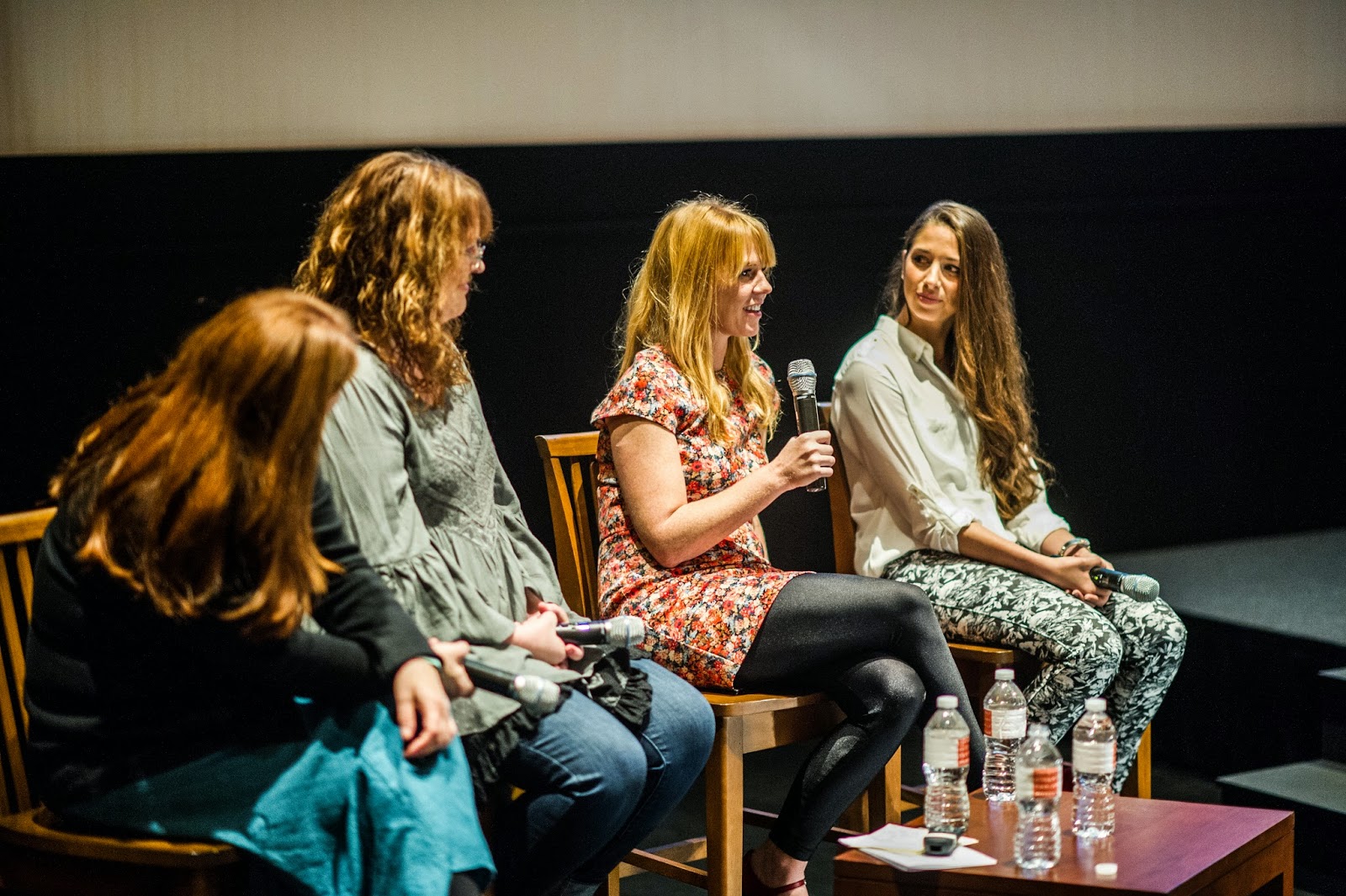
WALT DISNEY FAMILY MUSEUM HOSTS WOMEN IN ANIMATION PANEL: Luminaries in the industry showcase how to succeed and thrive in the fun and challenging world of television and feature film animation

The ILM theatre was a buzz on Saturday March 15th as animation veterans Jenny Lerew, Brenda Chapman, Claire Keane and Lorelay Bove regaled the packed house with stories of their work on films like The Lion King, Frozen, The Prince of Egypt, Tangled and Peabody and Sherman.


Audience members at the Women in Animation panel.

Presented by the Walt Disney Family Museum in conjunction with their latest exhibit, MAGIC, COLOR, FLAIR: the world of Mary Blair, WDFM’s public programs manager Mary Beth Culler and exhibition curator, animation director, and author John Canemaker introduced the Women in Animation panel.

Jenny Lerew, director of the hit 90s television show Animaniacs, author of The Art of Brave and most recently, storyboard artist for Peabody and Sherman, moderated the event for the over 200 animators and animation fans in attendance.

DISCOVERING ANIMATION: CALARTS AND BEYOND

Lerew kicked off the talk by answering a question she is often asked, usually by men, “Why aren’t there more women in animation?”

“It's a good question,” said Lerew. “I can tell you why this woman is in animation. Like all of us, I loved cartoons and I also grew up as an artist, I loved to draw." However, animation was not on her radar, until she learned about California Institute of the Arts, or CalArts, in high school.

In fact, Lerew first learned about Brenda Chapman through CalArts in 1987 after seeing her student film A Birthday. The film, about an old woman remembering her birthday as a little girl, made quite an impression on Lerew, and helped encourage her to tell her own stories.

"Now there are hundreds of places you can go and it's on everyone's radar,” said Lerew.

Brenda Chapman learned about CalArts from a friend of a family friend who worked at Disney Feature Animation. At the time story was not even offered as a course, so students learned from the upperclassmen. In 1987 she earned a spot as a trainee at Disney, where she was frankly told  “they were happy to have you. We needed a woman that's why you're here. And you have six months to prove yourself.”
Brenda Chapman, Claire Keane, John Canemaker, Jenny Lerew and Lorelay Bove at the event.

Prove herself she did, working as a story artist on Beauty and the Beast and
The Lion King at Disney, and later becoming the first woman to direct an animated film for DreamWorks' The Prince of Egypt.

Lorelay Bove, another CalArts grad, recalled being enthralled by the film Fantasia at age eight, a film, she discovered, that was not as beloved by her fellow classmates.

“Everyone at school hated it, but I loved it,” recalled Bove. Along with Disney films, she also experience art by spending time in her father’s art studio, where he worked as an abstract painter.
From a young age she knew she wanted to work at Disney, something that most people she knew in her native Spain did not understand.  After moving to the states with her family, her father found out about CalArts. She applied, was not accepted, but did not let that deter her. She studied at another college for three years, reapplied to CalArts, was accepted, and later served as an intern at both Pixar and Disney.

Bove then took a job as a visual development (Viz Dev) artist at Disney, working on The Princess and the Frog, Wreck-It-Ralph and this fall’s upcoming super hero adventure Big Hero Six.

Claire Keane took a different path, attending graphic design school and creating a storybook as her thesis.

"What I loved the most was all the research,” said Keane.

She loved creating developmental drawings, but did not believe that there was a way for her to create what she wanted for film. That was, until a conversation with her father, animator Glen Keane, changed her mind.

“Claire, that exists,” said Keane, laughing as she recalled her father’s words. “We have visual development artists at Disney.”

His advice inspired Keane to apply to Disney, where she worked as a Viz Dev artist on both Tangled and Frozen before leaving to work on her children’s book that will be released in 2015.

CREATING A FILM: ONE DRAWING AT A TIME

Each of the panelists along with moderator Lerew shared some of their favorite studio work, and a few of their personal projects, enabling the audience to glimpse a behind the scenes look at what goes into making a film.

“I can only work from what I know,” said Keane. “Anytime I start drawing something I don't have an emotional connection to I can't draw it. My hand just draws in circles.”

In order to create that emotional connection between herself and Rapunzel from Tangled, Keane stayed home one weekend documenting everything that she did, while at the same time imagining all of the activities Rapunzel would engage in if she were unable to leave her own home.

“Maybe she had an imaginative imagination,” said Keane. “What would her paintings look like in the dark. Happiness? Fear of the outside world? Chores? Make her bed, make candles, brush her hair. Fascination with birds -- they fly, they don't get eaten by monsters, they return.”
Claire Keane discusses her artistic process while at Disney.

The practice allowed her to get into Rapunzel’s head and see the world the way that the character would.

Lerew showed her boards and animatic from a scene of Peabody and Sherman, the first scene to be animated for the film. In the scene, Sherman reluctantly tells Mr. Peabody of an altercation he experienced at school. Lerew showed both the storyboards, as well as the final animation of the scene, to highlight the similarities

and differences between what goes into the boards and the final product.

Bove showed backgrounds from Sugar Rush, the racing game that serves as a turning point in last year’s hit film Wreck-It-Ralph. Her designs were inspired by Spanish homes that “looked like candy.” In fact, research is one of the best parts of the job.

“[We] went to a candy convention in Germany that was three stories tall. The Comic Con of candy,” said Bove.

Chapman showed boards from Beauty and the Beast where Belle nurses the Beast’s wounds, as well as the scene from Brave where Queen Elinore and Princess Merida clash and Merida slices through the family tapestry.

“This is the crux of the movie, it sets the scene,” explained Chapman of the scene from Brave.
Mom is trying to do her best, and the daughter is trying to exert her independence, according to Chapman, and both are right and wrong.

“Most fairytales involve moms or stepmoms that are either horrible or dead. I wanted to show a family,” said Chapman.

QUESTIONS FROM THE AUDIENCE

The panelists also took time to answer questions from the audience, ranging from what studios look for in a portfolio, and both Keane and Bove agreed that it was better to show your best work than a ton of everything.

 “Put in the best work that represents you,” said Keane. “Focus on the character or environment and make that image say what you want it to say.”

The panelists also addressed what it is like seeing your creation as merchandise.

“For the most part it’s very positive,” said Chapman. “If I can make one little kid forget their problems at home, then I’ve done my job.”

Chapman also addressed the darker side of merchandising, recalling the now famous incident of the change in Merida’s design from Pixar heroine to the more traditional Disney princess look.

“The ‘princessing’ of Merida was not good, I put up a stink about that,” said Chapman.

They also addressed the lack of female representation in film, and what creators can do to rectify the situation.

The key, said Keane, is to have “someone who is grounded in reality. No more clichés – that’s any character in animation, not just women.”

Chapman, and the other women on the panel, are living proof that animation will continue to inspire.  Now when she goes to lecture at CalArts, 52% of the women are students.

“Just do it,” said Chapman. “First, learn how to work in the studio system. Then, learn how to make your mark.”
---
Special thanks to the Walt Disney Family Museum for planning the event and providing the photographs, ILM for hosting, Jenny Lerew, Brenda Chapman, Lorelay Bove and Claire Keane for discussing their work and life through animation and John Canemaker for curating the WDFM exhibit.

And you can see more of the artists’ works on their websites:


John Canemaker
http://www.johncanemaker.com/

Brenda Chapman
http://brenda-chapman.com/

Lorelay Bove
http://lorelaybove.blogspot.com/
 

Claire Keane
http://claireonacloud.com/


Jenny Lerew
http://blackwingdiaries.blogspot.com/


And visit the Walt Disney Family Museum to see their latest exhibit:
MAGIC, COLOR, FLAIR: the world of Mary Blair through September 7, 2014

For information on Women in Animation San Francisco and animation events happening around the San Francisco Bay Area:


Visit our Website:

www.womeninanimationsf.blogspot .com

Join our Facebook Group:
https://www.facebook.com/wiasf


And follow us on Twitter:
@WIASanFrancisco

Tuesday, February 25, 2014

Guest Columnist Jenny Lerew: A Commentary on Women in Animation

In the 1970s there was one must-have for every aspiring young animator's bookshelf: Christopher Finch's oversized, heavy and beautiful The Art of Walt Disney.  Illustrated books detailing the history of animation, and more specifically, the Disney Studio, were almost nonexistent at the time; and at over 400 pages the Finch book was something I pored over for hours. I'd already fixed on the idea of being an animator, seeing it as the perfect career to marry my love of drawing, film, and performance.  I considered animation to be "the illusion of life": turning lines on a page into characters that lived and breathed in an invented world of color, design and graphic imagination.

Every page of Finch's book was filled with story sketches, animator's roughs, background paintings, and photographs– not just of Walt Disney, but also of his artists working at their desks, drawing just as I did and looking not much older than I was. But they were working on such memorable films as Snow White, Pinocchio, and Bambi.  Decades before I was born they'd managed to achieve the gold standard: working at the greatest animation studio in the world on films whose influence would long outlive them.

The old images fascinated me and I wanted to know more about them. One was particularly striking.  It showed a young woman, Retta Scott, animating on Fantasia.  While far from being an expert in either social history or 1930s studio-hiring practices, I knew that a woman employed as an animator in those days was rare, and that this had been the case from the beginning. The form of cartooning which preceded and inspired animated cartoons and newspaper comic strips, also had many more men than women employed in the field, and this disparity carried over into the new medium of animated cartoons. With rare exceptions, cartooning/animation work became a "guy's thing," though the intended audience for the cartoons and comic strips was both male and female.

So, by the mid-1930s, it seemed that any woman with artistic talent or experience who applied to a studio for work in animation was limited to a career in the "ink and paint" department, doing the crucial but creatively stultifying tasks of tracing animators' drawings on celluloid and painting the underside. This was by necessity an assembly-line sort of job, and while the women who did it were rightfully proud of their skills, the work certainly didn't allow for individual expression.  But there was Retta Scott, engaged in what was a traditionally male job. She was an anomaly—a female animator!  I later learned that Scott had worked in the story department as well as in animation, and in fact, there had been other women assigned to the story and development departments, including Sylvia Moberly-Holland, Bianca Majolie, and most famously, Retta's friend Mary Blair, whose career and influence would extend further than many of her colleagues'.

In the 1930s and '40s, a confluence of talent, opportunity, timing and connections were required for a talented woman to land a creative job at Disney.  This was also true for the men but to a lesser degree. It's impossible to know how many women who aspired to be animation artists were actively discouraged from trying, but certainly some were, as evidenced by the Disney Studio's 1930s form letter sent in response to women inquiring about jobs as artists. It stated that "women do not do any of the creative work in connection with preparing the cartoons for the screen, as that work is performed entirely by young men." While clearly untrue when one considers the placement of the women previously mentioned, the letter nonetheless expressed the company's attitude towards the idea of women artists in general.

This was unfortunate since not only were women at the Studio making artistic contributions, their work was also having a positive impact on the history of animation. The work of Mary Blair, in particular, caused a transformation in the look of Disney animation, and the opportunity for her to create stunning art was due to the direct involvement of Walt Disney, whose appreciation of her unique style and sensibility was not hindered at all by her gender. But Blair was a stunning exception; for most women, the opportunities to achieve personal distinction in animation were simply not available. Had it been otherwise, it's anyone's guess who else might have made her mark as Blair was able to.

Throughout my working life I've been asked the question, "Why aren't there more women in animation?" and I've never had an answer. I can only speak for myself and explain why I do what I do—a story that differs little if at all from that told by my female and male colleagues.  But while the question still gets asked, things have changed more rapidly in recent years than ever before. As a student at Calarts in the late 1980s, I was in a class where the guys far outnumbered the girls, and for the first decade or so I was able to tick off the names of all the other females who were somehow involved in animation.

Now, there are so many women working in the field that I can't begin to keep track of them all– many working as I do in story, but also in visual development, animation, character design, and every other classification. Online blogs by aspiring female animation students are even more numerous, and from a cursory check, show ever-increasing sophistication and range in personal style and storytelling ability.  It's a wonderful state of affairs for my industry and for everyone who's involved with the art of animation, and it'll be fascinating to see what the future will look like when a picture of a woman creating animation will draw no special notice at all.

Jenny Lerew is an animation story artist whose numerous film and television show credits include Animaniacs, Bee Movie, Shrek 2 and the soon to be released Mr. Peabody & Sherman. She is also the author of The Art of Disney/Pixar Brave available through Chronicle Books. 

You can see her at the upcoming Panel Discussion: Women in Animation hosted by the Walt Disney Family Museum and held at ILM on Saturday, March 15th. 

For more information on Jenny Lerew please visit her website at http://blackwingdiaries.blogspot.com/ or follow her on Twitter @blackwingjenny

Thank you to Jenny and the Walt Disney Family Museum for making this article and the upcoming talk possible. 

Monday, February 24, 2014

Walt Disney Family Museum Presents TALK | Panel Discussion: Women in Animation March 15th @ ILM

This Just in!

Due to the overwhelming response to the upcoming Women in Animation Panel hosted by the Walt Disney Family Museum the venue has been moved to the Lucasfilm/ILM Premier Theater

and ticket sales have been increased to accommodate more people.

Anyone interested in purchasing a ticket to this highly anticipated presentation can visit the Museum’s website at www.waltdisney.org. 

Schedule for March 15th:

11am-12:30pm Presentation at Lucasfilm/ILM Premier Theater
(Metered parking available at the Museum or side streets by Lucasfilm, or in the Lucasfilm garage for $5.00) [Lucasfilm/ILM is located in the Letterman Digital Arts Center at One Letterman Drive, just inside the Lombard Gate on the eastern end of the Presidio. It is a 15min. walk (.6 miles) from the Museum.] TALK | Panel Discussion: Women in Animation Sat, Mar 15 |11am Four top female animators discuss how women have found success working in a male-dominated industry, their personal struggles and triumphs, their thoughts about the career and influence of artist Mary Blair, and the future of women in animation. Featuring moderator Jenny Lerew and animators Brenda Chapman, Lorelay Bove, and Claire Keane. Presented in conjunction with the special exhibition MAGIC, COLOR, FLAIR: the world of Mary Blair.

Photo Courtesy of the Walt Disney Family Museum
1-1:30pm – Signing at The Walt Disney Family Museum (lower level) 3-5pm – Learn from the Masters class with Brittney Lee (Learning Center) 10am-6pm- Museum hours;

New exhibition, MAGIC, COLOR, FLAIR: the world of Mary Blair open to the public in the Special Exhibition Hall

WORKSHOP | Learn from the Masters with Brittney Lee Sat, Mar 15 | 3-5pm | limited to 15 students per class | ages 18+ Join visual development artist Brittney Lee as she discusses and demonstrates her process of working with cut-paper. Learn some basic paper-sculpting and construction techniques and create a small original work of your own.

Please contact publicprograms@wdfmuseum.org if you have further questions.  

Thank you to our friends at the Walt Disney Family Museum for creating and hosting this amazing event!

Saturday, January 25, 2014

Head of Animation Lino DiSalvo Talks Art of Frozen at Walt Disney Family Museum

Enthusiasm for Frozen was palatable at the sold out Frozen: Art of Animation talk Friday night at the Walt Disney Family Museum. Lino DiSalvo, head of animation for the film and a Disney vet with over 15 years of experience at the company, led the audience on a fantastic and sometimes harrowing journey through the process of creating Disney’s 52nd animated feature film.

A Musical for Even Non-Musical People

“We watched every musical ever created,” DiSalvo said with a laugh as he chronicled the storytelling process. “[And] I started this journey hating musicals.”

It wasn’t the music he hated. DiSalvo grew up on classic Disney musicals and loved film. It was the “yearning look into the horizon” that truly bothered him. He, along with the many other individuals who enabled the film to become a reality, wanted something more heartfelt for their heroines and the other characters.

He wanted the emotion of the characters to be so organic that they could not help but sing. “The scenes that worked in these films with singing, [there was] no other way for the character to convey the emotion they felt,” said DiSalvo. The dynamic duo of Tony Award winning scribes Kristen-Anderson Lopez and Robert Lopez enabled that vision to become a reality.

“They were awesome,” said DiSalvo.


Adventures in Compelling Storytelling – Elsa’s Journey 

Two of the other great challenges when creating the film were crafting the story and dealing with a tight production schedule. The Snow Queen remained on Disney’s radar for years, but it was not until Chris Buck and Jennifer Lee signed on as directors and Lee hemmed the version of Frozen that is now in theaters that the film truly clicked. One of the toughest parts was getting the story right. Their goal was to create a compelling narrative devoid of cliché. One major issue was that Elsa, the snow queen herself, played too much like a villain. This made it difficult for the staff to want to root for her by the end of the film.

“It’s a 90 minute film and you want to like the characters,” said Wayne Unten, supervising animator for Elsa. “To get her to the mountain top for ‘Let It Go’ you have to show what she’s been through. The villain part wasn’t working.” The story came together when Lee showed the staff the bond that needed to exist between Elsa and her sister Anna, and how that bond would ultimately save them.

“The film is family love, not romantic love,” said DiSalvo, crediting Lee with bringing to light the theme of the film. “Everyone in the room said that’s the film we have to make.”

To further illustrate the importance of this point, the directors held a “Sister Summit,” said DiSalvo, where every woman on the team brought in their sister to sit and talk about what it was like living with a sister. This provided a wealth of information to everyone on the crew and helped solidify in their minds the type of relationship they wanted Elsa and Anna to experience.

Time Waits For No One 

Another major challenge was the release schedule. Originally slated for a 2014 release, the studio made the decision to release the film a year early in order for Frozen to be released for the Thanksgiving season, and to give Disney’s next animated release, Big Hero 6 a chance to shine during the following holiday season.

“When we went from 14 to 13 everybody freaked out,” said DiSalvo. “When we calmed down, we figured out how we were going to do this.” They succeeded in finishing the film by being efficient, said DiSalvo, solidifying the story, making solid acting choices, and overall working with some of the most talented individuals in the industry.

Life at Walt Disney Animation Studios 

Audience members got a rare look into the inner workings of the Disney studio in Burbank, including photos of the story room, animator’s offices and the coup de resistance, a giant 'A' where animators who have completed their first film sign their names alongside revered Disney veterans like Glen Keane.

“The building says animation but it should say collaboration because that’s what we do,” said Unten.

DiSalvo explained the process of filmmaking at the studio, starting first with the three touchstones of what Disney strives for in all of its films: compelling stories, believable worlds and appealing characters. He also touched on five aspects of the making of Frozen that were crucial during the visual development, story and animation processes. These five enabled the artists to stay true to the character of the film and create a compelling story.

Truth in Acting 

“Truth in Acting, “ said DiSalvo, “was the most repeated phrase during the entire production.” Disney brought in an acting coach who helped the staff delve into what defined each of the characters on screen. This included imagining the lives of the characters before and after each incident in the film. By pulling the bits and pieces from the characters lives, the artists were then able to achieve a stronger emotional core for Elsa, Anna and the other characters.

Along with working with an acting coach, the staff also hosted "Inside the Actor Studio" sessions with the voice actors, taking notes and recording how they sang so they could infuse the same level of resonance and emotion in the animated characters. The acting sessions with the acting coach along with working closely with the voice actors, as well as the animators acting out and thumbnailing character moments themselves, allow the heroines, heroes and villains of the film to be fully fleshed out characters instead of caricatures.

Casting and the Emotional Crescendo Board 

The film crew created a “crescendo board,” said DiSalvo, a literal board mapping out the conflict and resolution of every scene in the film. This allowed them to track the highs and lows experienced by the characters so that they could build to pivotal sequences in the film without giving away too much information early on. It was crucial to follow the board to ensure that the artists build up the character to a specific emotion.

“The goal is believability,” said DiSalvo. “We don’t want it to be real. We want it to be believable.”

Research 

Every film requires hands on research, especially one set in a world of snow and ice. Disney sent the animators to Wyoming to explore what it would truly be like to live in a snow-covered kingdom. This led to crazy scenarios, including the animators tromping around in full length wool skirts to see just how difficult it would be for Anna to maneuver around. They also held races in the snow and soon discovered that it is incredibly difficult to run in knee-deep snow without falling on your face.

Hand-drawn and CG Tests 

Collaboration with hand drawn artists, according to DiSalvo, is one of the most fun things about the film-making process.

The story team, visual development artists and animators worked closely together to flesh out the character arcs of the characters in the film. Among the many artists who helped flesh out the characters were Bill Scwab and Jin Kim, who DiSalvo credited for helping to bring some of the great expressions of the characters to life.

Elsa character designs by Jin Kim


Anna character designs by Jin Kim


The animators then went on to create screen tests to show the emotional range of the characters. These tests were later used as teaser trailers, including the ones below for Elsa, Olaf, Kristoff and Sven.


Acting in Animation 

“If you can capture that little truth you’re on your way to something honest there,” DiSalvo said about the acting process. Each day the animators gathered in a room to watch the dailies, where the supervisors and directors watched their shots and gave notes. It was in dailies where DiSalvo and the team could analyze the acting, subtext and gesture of the characters to make sure that they flowed well within the story. “As animators we flesh out what the character is thinking and feeling,” said Unten.

“If there’s no heart behind the animation, then you’re just animating for the sake of animating,” said DiSalvo. For this reason the analysis went beyond the typical animation critique, which often focuses more on mechanics, such as fixing pops and improving arcs, and more about the acting.

Bringing the Characters to Life 

The high attention to acting and drama paid off for one of the most pivotal turning points in the film, the ‘Let It Go’ sequence, when Elsa transforms from Queen of Arendelle to the Snow Queen herself. Unten spent five weeks animating the sequence, spending his days supervising his animation team and his nights animating the sequence.


“Each of us has different methods,” said Unten, “but the goal is the same, to create amazing characters.” His method included watching recording sessions with Tony award-winning actress and voice of Elsa Idina Menzel, acting out expressions himself, thumbnailing his ideas, animating the sequence, receiving notes from COO of Walt Disney and Pixar Animation Studios John Lasseter, and animating again. It is a painstaking process, but one deserving of the time.

“It’s not just a music video, every line means something,” said Unten.

Parting Words 

The evening ended with DiSalvo and his team fielding questions from the eager members of the audience, who included everyone from students and professionals to small children.

DiSalvo gave a particularly good piece of advice to students, who are often inundated with cynicism from the industry.

"These movies are a hard journey," said DiSalvo, and he credited the talent of his staff for making Disney a great place to work and make films. 
 
“I think Frozen is a great example of artists believing in each other,” said DiSalvo.

And it is this belief that will continue to inspire future artists and animators the world over.

Special thanks to Walt Disney Animation Studios, the Walt Disney Family Museum, Head of Animation Lino DiSalvo,  Animator Amy Smeed, Animation Supervisors Wayne Unten and Jason Figliozzi and Walt Disney Animation Studios Director of Talent and Development and Outreach and Women in Animation Secretary Dawn Rivera-Ernster for this excellent event.

And for more info on Women in Animation San Francisco visit our Facebook Page at:
https://www.facebook.com/wiasf

and Twitter at:
https://twitter.com/WIASanFrancisco

Secretary Dawn Rivera-Ernster 
Director of Talent Development and Outreach at Walt Disney Animation Studios
Secretary Dawn Rivera-Ernster 
Director of Talent Development and Outreach at Walt Disney Animation Studios

Sunday, September 22, 2013

Andreas Deja and Carol Kieffer Police Wow the Crowd at the Walt Disney Family Museum


Saturday Sept. 21st members of Women in Animation San Francisco had the great pleasure of meeting and hearing animation legends Carol Kieffer Police and Andreas Deja discuss their careers and work on Bambi II at the Walt Disney Family Museum. The pair in front of a sold out audience in the Disney Theater first discussed how they came to excel in their respective careers.

Ms. Police's career spans the gamut from feature films to television, including animating on The Lord of the Rings, and serving as a layout artist for Ducktales: The Movie, Home on the Range, and art director for Tinker Bell, Bambi II, and as a location development artist for Shrek.

From left to right top: Sarah Fenton, Carol Kieffer Police, Andreas Deja, Angela Entzminger, and Diana Martinez. Bottom left to right: Kristen Sanzari, Samia Khalaf, Jasmine Truong, and Marji Fortin.

Mr. Deja is well known for his work at Disney, where he worked for 31 years, serving in many roles such as supervising animator on classic characters like Roger Rabbit, Mickey Mouse, King Triton, Scar, Jafar, Gaston, Lilo, and Tigger.  

A native of Germany, Mr. Deja dreamed of working on Walt Disney animated features, and took his first life drawing course at the impressionable age of 16. Although he earned a degree in graphic design, he longed for the world of animation. Since their were few formal classes he could take, he resorted to creating assignments for himself, such as animating walk cycles for various types of people, big and small, and animating horses. His persistence paid off and in August 1980 he became a member of the Disney Training Program led by animator Eric Larson.

Stateside, Ms. Police dreamed of becoming a renowned fashion illustrator in New York City. Her mother, president of the National Watercolor Society and an accomplished painter and illustrator in her own right, created the catalyst that led to Ms. Police's determination to excel in her field. She attended Art Center College of Design and the week before graduation, was hired by Ralph Bakeshi to work on the animated The Lord of the Rings. "You can do all the pretty stuff in the movie, " Backshi said upon seeing her illustrative work. Afterwards, she received a call from legendary animator Richard Williams. "I'll hire you for one hundred dollars a day and teach you what I know," said Williams. For the next three years, she worked with both Williams and animator Art Babbitt, gleaning a wealth of experience in the world of animation.

As the crowd of students, professionals and animation fans listened in awe, Ms. Police and Mr. Deja chronicled the ups and downs of their careers. Above all, Ms. Police urged students to "...not be afraid of being afraid. Fear is the great motivator." "Just do it," she said. "You guys will be great. Use your brain. Draw, draw, draw."

Along with discussing their careers, the pair also discussed the art of Tyrus Wong, now on display at the Museum through the fall. They analyzed Mr. Wong's lyrical style in his paintings, his sense of line and motion, as well as the shape detail of his backgrounds and characters. Influenced by the Chinese Sung Dynasty, it was Mr. Wong's unique style using gouache studies that led the Disney studio to hire him as a background artist on Bambi. "Bambi is one of those films where one artist was able to put their stamp on the film. That doesn't happen that often," remarked Mr. Deja on Mr. Wong's artistic sensibility.

Mr. Deja entertained the crowd with stories he heard firsthand from luminaries like Marc Davis, Ollie Johnston, Frank Thomas, and Milt Kahl, who all worked on the feature. As Mr. Deja explained, "Even they didn't know they could do this." This was the first time Disney feature films had ever crafted realistic looking creatures, even more so than in other films like Snow White and Bambi. Disney's excitement encouraged them, said Mr. Deja. These were not individuals who had studied deer for decades, these were artists in their 20s , figuring out new ways to draw.

Mr. Deja and Ms. Kieffer Police ended the session by answering questions about everything from where they felt 2D was heading in the future to more in depth discussions of Bambi. Mr. Deja even gave a demonstration on how to draw the famous faun in under 10 minutes.

Special thanks to Mr. Deja and Ms. Police for their entertaining lecture.

Very Special thanks also to Walt Disney Family Museum Public Programs Coordinator Mary Beth Cullen as well as the numerous volunteers at the Museum and the staff at the California College of Arts who made the event possible.

Visit Mr. Deja's blog at http://andreasdeja.blogspot.com/

Visit Ms. Police's studio site at: http://www.madeinparadiseprod.com/

For more information on the Walt Disney Family Museum and their upcoming events, visit their website at www.waltdisney.org


For more information on Women in Animation San Francisco and to get updates on other animation related events in the Bay Area, check out our Facebook page:
 

https://www.facebook.com/wiasf
 

And Twitter:
 

@WIASanFrancisco